
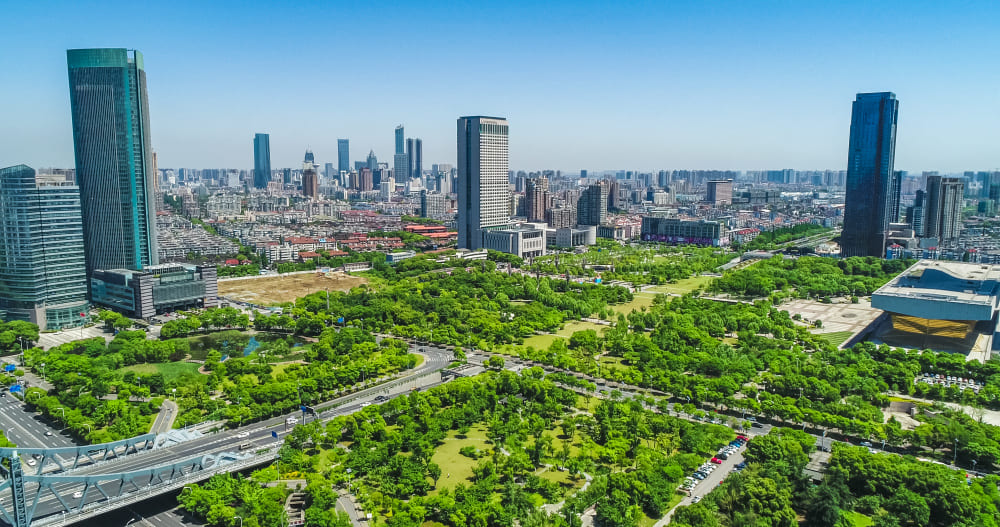

The world is becoming urban — and faster than ever.
Today, around 4.7 billion people, or 58% of the global population, live in urban areas. By 2050, that share is expected to rise beyond 70%. Much of this growth will take place in developing regions, particularly across Africa and Asia, where cities are expanding rapidly and new urban centres are emerging.
This growth presents an enormous opportunity. Cities concentrate people, businesses, infrastructure, innovation and economic activity, making them powerful engines of development. Which is why the decisions being made today about housing, transport, buildings, waste, infrastructure and public spaces are critical. They will shape how these urban areas function for decades to come.
Cities are responsible for roughly 70% of global greenhouse gas emissions, while also facing growing exposure to heat, flooding, water stress and other climate-related risks. Urban growth, therefore, is not simply a question of accommodating more people. It is about ensuring that the systems supporting urban life can remain efficient, inclusive, resilient and environmentally sustainable as cities expand.
Sustainable urban development is not simply about building infrastructure. It is about rethinking how cities are designed, built and managed so that economic development does not come at the expense of environmental health or quality of life.
One of the clearest places to see this tension is in the way cities deal with waste.
As urban populations and consumption grow, the amount of waste generated by households, businesses and construction activities increases. In many cities, the response has largely been collection and disposal. But this approach misses the economic value contained within what we call waste.
Food and organic waste can become compost or, through appropriate systems, a source of energy. Paper, glass, metals and plastics can be recovered and returned to production rather than requiring new raw materials. Construction and demolition materials can be reused, recycled or processed into inputs for new projects.
This shift from waste disposal to resource recovery can create an entirely different urban economy.
It creates demand for waste collection, sorting, recycling, repair, refurbishment, composting and material recovery services. It can support small businesses and informal workers whose livelihoods already depend on recovering valuable materials. It can also create opportunities for larger enterprises to develop new products and services around circularity.
The value, therefore, is not only in reducing what ends up in a landfill. It is in creating systems where materials remain productive for longer, businesses develop new revenue streams and employment opportunities emerge around recovering value from resources.
This is particularly important for rapidly growing cities where land for disposal is limited and municipal budgets are under pressure. A city that treats waste as a resource is not simply managing a sanitation problem; it is building part of its circular economy.
Read also: Africa’s public sector needs a new accountability model
Mobility presents another important urban development challenge.
The way a city is designed influences how far people need to travel, what transport options are available to them and how much time and money they spend moving around. Cities built around private vehicles tend to require more road space and can experience congestion, air pollution and significant transport costs.
Sustainable mobility is therefore about more than replacing petrol and diesel vehicles with electric ones. Electrification can reduce emissions, but it does not by itself resolve congestion or the amount of urban space dedicated to moving and storing vehicles.
A more sustainable approach considers the entire mobility system.
Reliable public transport can move large numbers of people more efficiently. Safe walking and cycling infrastructure can make short journeys possible without a vehicle. Transit-oriented development can place homes, workplaces and services closer to public transport. Digital systems can improve route planning and integration between different modes of transport.
This also has a social dimension. A city where people can easily reach employment, healthcare, education and markets without owning a private vehicle is fundamentally more accessible.
In this sense, sustainable mobility is not just about how people move. It is about whether people can access opportunity.
The same principle applies to green spaces, which are sometimes treated as aesthetic additions to urban development rather than essential infrastructure.
Trees, parks, wetlands, urban forests and green corridors perform functions that cities increasingly need. Vegetation can provide shade and help moderate urban temperatures. Wetlands and permeable landscapes can absorb and slow stormwater. Trees and plants can contribute to air-quality improvement, while connected habitats support urban biodiversity.
These functions become increasingly valuable as cities experience more extreme heat and intense rainfall.
Consider a heavily built-up neighbourhood with extensive concrete and limited vegetation. During extreme rainfall, water has fewer places to infiltrate, increasing pressure on drainage systems. During periods of extreme heat, there is limited shade and little natural cooling. Now consider a neighbourhood where trees, parks, permeable surfaces, drainage channels and restored waterways have been deliberately incorporated into the urban design. The same natural features can provide recreation while also helping the city manage climate risks.
This is why green infrastructure and nature-based solutions deserve to be considered alongside roads, drainage networks and other conventional infrastructure.
But the benefits of green spaces extend beyond climate resilience. Public parks and accessible natural areas provide places for exercise, recreation and social interaction. They can contribute to mental wellbeing and improve the quality of neighbourhoods. The challenge is ensuring that these benefits are distributed equitably rather than concentrated in wealthier parts of a city.
Infrastructure and the built environment are another major part of this equation. The way cities build and maintain roads, drainage networks, water and wastewater systems, energy infrastructure, public transport and buildings determines how efficiently resources are used and how well communities can withstand climate and environmental pressures. Buildings, for example, can reduce energy and water demand through passive design, efficient systems, sustainable materials and renewable energy. At the same time, resilient drainage can reduce flood risks, reliable public transport can improve accessibility, and efficient water and energy infrastructure can help cities manage growing demand and resource constraints.
This means sustainable urban development cannot focus on individual buildings or infrastructure projects in isolation. A highly efficient building may still contribute to an unsustainable urban system if it is poorly located, disconnected from public transport or dependent on resource-intensive infrastructure. Similarly, roads, drainage, water, energy and sanitation systems need to be planned in relation to land use, population growth, climate risks and one another. The focus is therefore shifting towards connected urban infrastructure and the built environment — creating neighbourhoods and cities where buildings, transport, utilities, green spaces and essential services work together to support resilience, efficiency, accessibility and quality of life.
The most effective urban development therefore comes from seeing these elements as connected rather than as separate projects.
A new housing development, for example, can incorporate energy-efficient buildings, accessible public transport, green spaces, waste separation and water-efficient infrastructure from the outset. These decisions reinforce one another. Efficient buildings reduce energy demand; green spaces can provide shade and manage stormwater; good public transport reduces dependence on private vehicles; and resource recovery systems can reduce waste while creating economic activity.
This integrated approach becomes even more important as climate change alters the conditions in which cities operate.
Urban planners and developers increasingly need to ask not only whether infrastructure meets today’s needs, but whether it will continue to function under future conditions. Will buildings remain comfortable during more frequent heatwaves? Can drainage systems cope with heavier rainfall? Can transport networks continue operating during extreme weather? Will critical services remain accessible to communities during disruptions?
Climate resilience needs to become part of these decisions before infrastructure is built, rather than being treated as a response after disruption occurs.
There is also a question of who benefits from sustainable urban development.
A city can have advanced green buildings, efficient public transport and attractive parks while large sections of its population remain unable to access affordable housing, reliable services or safe public spaces. Sustainability that does not consider affordability, accessibility and inclusion risks creating greener cities that are still deeply unequal.
This is particularly relevant in rapidly urbanising regions, where informal settlements and underserved communities are often exposed to the greatest environmental and climate risks.
Sustainable urban development therefore requires more than individual green interventions. It requires a different way of thinking about urban growth — one that considers resources, infrastructure, economic opportunity, environmental systems and human wellbeing as interconnected.
The opportunity is significant.
Waste can become a source of materials, businesses and employment. Mobility systems can connect people to opportunity while reducing emissions. Green spaces can become part of a city’s climate resilience and infrastructure can reduce resource consumption while creating healthier and more comfortable environments.
But none of these solutions works in isolation.
The city of the future will need to function as a connected system, where decisions about buildings consider transport, transport planning considers land use, green spaces support climate adaptation, and waste systems contribute to a circular economy.
The question facing rapidly growing cities is therefore not simply how much they should build, but what they should build, where they should build it and how those systems will work together.
The choices made today will shape the environmental footprint, economic opportunities and quality of life of urban populations for decades.